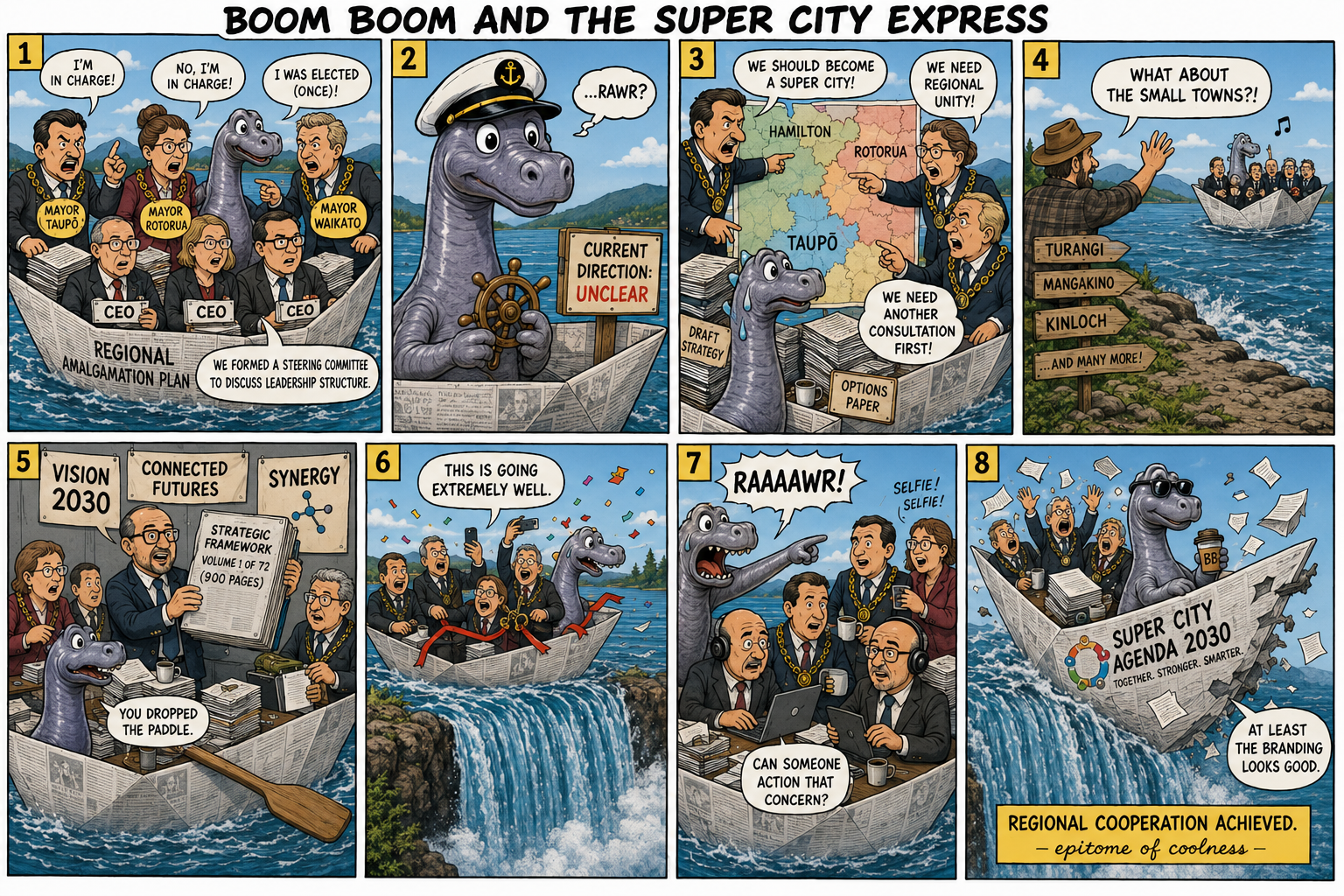
Well… this suddenly got real.
For years, talk of council amalgamation in New Zealand has floated around like one of those ideas politicians bring up every few summers before quietly shelving it beside the broken office printer and the community engagement framework.
Now the Government has effectively told councils:
you have three months to start figuring this out.

And suddenly the paper boat doesn’t feel so fictional anymore.
Christopher Bishop has signalled that councils are expected to come forward with reform ideas including shared governance, restructuring, and possible amalgamation, or risk central government stepping in later.
That’s not a small conversation.
That’s potentially the biggest shake-up to local government since Auckland became the Super City.
And honestly?
A lot of ratepayers seem to be reacting somewhere between cautious curiosity, exhausted cynicism, and Boom Boom screaming “RAAAWR” while the paper boat heads toward a waterfall.
Why people are uneasy
The Government says the current system is too fragmented and too expensive.
To be fair, there’s truth in that.
Infrastructure costs are exploding. Water systems are aging. Insurance costs are brutal. Roads, wastewater, bridges, stormwater and growth pressures are hammering councils across the country.
Many ratepayers can already feel it every time rates notices arrive.
But the concern isn’t just what is happening.
It’s how fast it’s happening.
Three months feels incredibly short for discussions that could permanently reshape:
• representation,
• local identity,
• infrastructure control,
• debt,
• staffing,
• planning,
• and how communities are governed for decades.
This is not exactly the kind of thing you want rushed through over a long weekend and a stack of consultant reports.
Taupō sits in a strange position
Taupō already sits in a strange administrative position.
We pay rates to Waikato Regional Council.
We also have Taupō District Council.
Regional responsibilities already overlap in weird ways:
• water,
• flood management,
• environmental regulation,
• transport planning,
• emergency coordination.
So from a structural point of view, some people will naturally say:
“Well… joining more closely with Waikato would make more sense than some random mega-structure elsewhere.”
Others hear the word regionalisation and immediately picture Hamilton calling the shots, giant bureaucracy, and small towns quietly disappearing off the map. Neither reaction is irrational.
Bigger does not automatically mean better
This is the part people keep dancing around.
Amalgamation is often sold politically as “efficiency”.
But scale alone does not magically create competence.
New Zealand already has examples where larger systems have struggled:
• infrastructure pressure,
• governance dysfunction,
• public distrust,
• ballooning costs,
• and leadership controversies.
People look at some councils around the country and quietly wonder:
“Are these really the systems we’re meant to copy?”
That’s not anti-reform.
That’s due diligence.
The small town question
This is the real issue sitting underneath all of this.
What happens to:
• Tūrangi,
• Mangakino,
• Kinloch,
• Whakamaru,
• Omori,
• Motuoapa,
• and smaller communities
inside giant regional structures?
Because many already feel like they struggle for attention now.
When decisions become more centralised, communities naturally worry that:
• urban centres dominate,
• local representation shrinks,
• and smaller towns become budget footnotes.
That concern is not paranoia.
It’s one of the most common criticisms of amalgamation worldwide.
The awkward truth
Here’s the uncomfortable part:
I actually understand why the Government is looking at this.
Councils are under serious pressure.
Taupō itself is not immune from criticism.
Ratepayers are watching:
• ongoing rates rises,
• long-term lease commitments,
• staffing growth,
• infrastructure delays,
• consultant spending,
• executive salaries,
• and large organisational structures.
People are asking hard questions.
And frankly, they should.
But I’m not convinced simply making councils bigger automatically fixes those underlying issues.
Sometimes larger systems reduce duplication.
Other times they simply create:
• bigger management layers,
• larger communication departments,
• more consultants,
• more complexity,
• and decision-makers further away from the communities paying for it all.
“Current direction: unclear”
That’s probably the best summary of where New Zealand local government feels right now.
Not collapsing. Not stable. Not fully broken. Not fully trusted either.
Just drifting toward a very large conversation very quickly.
Maybe reform is necessary. Maybe some councils genuinely cannot sustain the current model forever. But if New Zealand is about to redraw local government, ratepayers deserve more than slogans, urgency, and another 900-page strategy document explaining why the paper boat is technically still afloat.
And somewhere in the middle of all this, Boom Boom might actually be asking the most sensible question of all:
“What about the small towns?”
Epitome of Coolness

Leave a Reply