Or how I somehow squeezed 64 pages into ten lines.
If you ever picked up my Lunch Club Letters and wondered how on earth I managed to explain Council’s Annual Plan in just ten lines, here’s the secret…
The official version is 64 pages long.
Actually, the real Annual Plan is even longer once you include all the supporting information, colourful graphs, glossy photos and enough carefully polished language to make you feel like you’ve achieved something just by reaching the last page.
This year’s condensed version, however, feels a bit like the science project someone remembered to hand in five minutes before the bell rang.
The Mayor opens by saying Council had to make “difficult decisions”, keep rates under control and decide which projects to keep, defer or cut.
Fair enough.
I thought, “This is going to be brutal.”
I expected to find major infrastructure projects cancelled, departments slashed and Council making some genuinely painful choices.
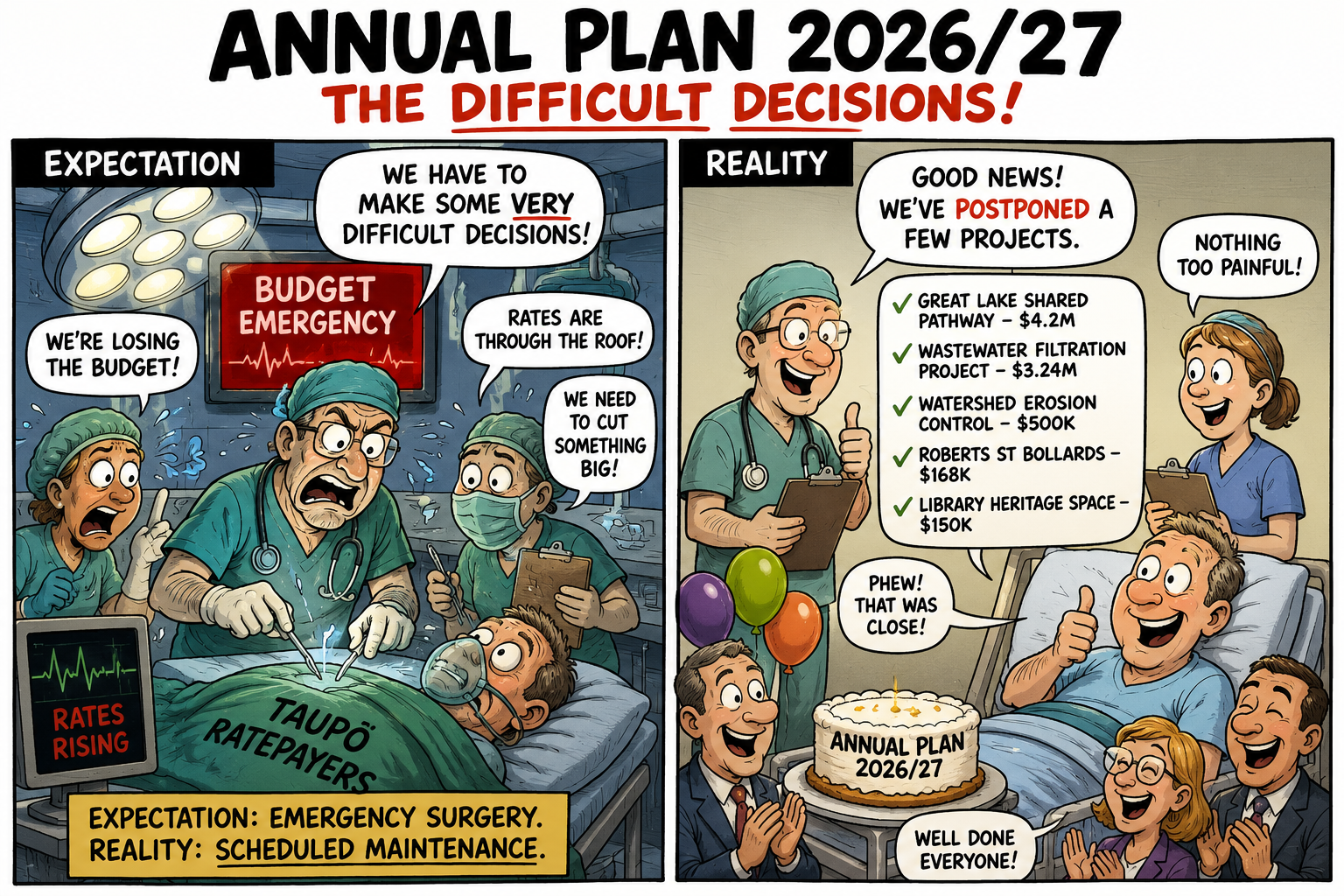
Instead, I found this.
- Great Lake Shared Pathway Extension – $4.2 million deferred.
- Taupō Wastewater Side Stream Solids Filtrate Treatment – $3.24 million delayed because central government changed the wastewater standards.
- Project Watershed Erosion Control – $500,000 deferred because physical works haven’t started yet.
- Roberts Street removable bollards – $168,000 deferred.
- Community heritage space at Taupō Library – $150,000 deferred.
That’s… it.
Don’t get me wrong. Delaying projects is still a decision.
But after reading the introduction, I was expecting the financial equivalent of emergency surgery.
Instead, it felt more like deciding to paint the Great Lake Centre green poo brown.
The one project that genuinely stood out to me was the wastewater filtration project. If central government changes the rules halfway through the process, it makes sense to pause, reassess the design and avoid spending millions on something that may no longer meet the required standards.
The others?
Personally, I think delaying the shared pathway was the right call.
I understand the desire to beautify Taupō. Shared pathways have value. They encourage walking, cycling and enjoying the lakefront.
But if Council is talking about difficult financial decisions, rising rates and increasing pressure on essential infrastructure, I struggle to see another $4.2 million shared pathway as an urgent priority.
Over the past year I’ve had this conversation with a lot of Taupō residents.
The answer is usually the same.
“Fix the essentials first.”
Water.
Wastewater.
Roads.
Stormwater.
The things that keep a district functioning every single day.
Communities like Mangakino have raised concerns about wastewater infrastructure, and there are ageing assets across the district that will need ongoing investment. When budgets are tight, I’d rather see money spent underground than poured into another stretch of concrete.
What struck me most wasn’t the list of deferred projects.
It was the contrast between the introduction and the list itself.
The introduction prepares readers for painful sacrifices.
The deferred projects read more like sensible timing decisions than drastic cuts.
Maybe that’s the real story.
Not that Council made difficult decisions.
But that the difficult decisions weren’t quite as dramatic as the introduction first led me to believe.
After all, if postponing a shared pathway is one of the toughest calls in this year’s Annual Plan, perhaps the budget wasn’t quite the financial cliff-edge the opening pages make it sound like.
That doesn’t make the Annual Plan a bad document.
It’s just… an Annual Plan.
It tells us where Council intends to spend your money over the coming year. The numbers matter. The projects matter. But the questions matter just as much.
Because an Annual Plan isn’t just about balancing the books.
It’s about deciding what comes first.
And that’s where I think the conversation should continue.
When budgets are tight, should councils only be looking at what to cut?
Or should they also be looking at how to generate more value from the assets they already have?
Could Council generate more revenue instead of relying almost entirely on rates?
Could some services be delivered differently?
Could more work be done in-house where it makes financial sense?
Could valuable recyclable materials create more income for the district instead of simply becoming someone else’s resource?
Could more local businesses play a role in delivering Council services and contracts?
I don’t have all the answers.
But I think those are the conversations worth having.
Every dollar Council spends starts as a dollar earned by someone else.
That’s why ratepayers have every right to ask difficult questions about where that money goes, what alternatives were considered, and whether priorities have been set in the right order.
That’s not being anti-council.
That’s being an interested ratepayer.
Because an Annual Plan isn’t really a book of numbers.
It’s a list of priorities.
And priorities tell you far more about an organisation than colourful graphs ever will.
Disclaimer: This article is an opinion piece based on Taupō District Council’s Annual Plan 2026–27 and my own interpretation of its priorities. Opinions are my own, and I encourage readers to read the Annual Plan themselves and draw their own conclusions.


Leave a Reply