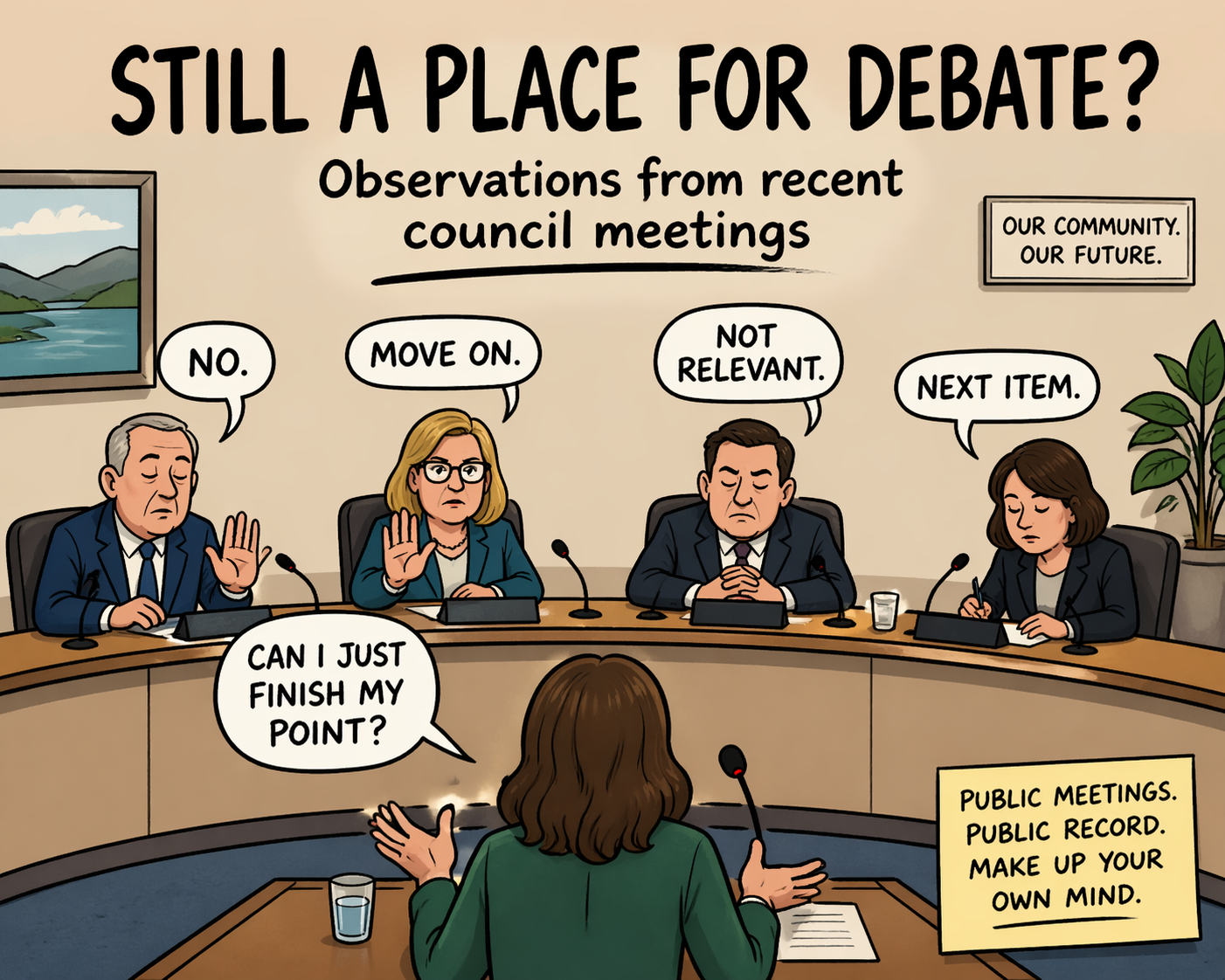
I briefly touched on this in my last opinion piece, the growing gap between how things are said inside the council chamber versus outside of it.
The tone changes.
The posture changes.
And increasingly, so does the tolerance for debate.
Now my attention has turned to the 31 March Taupō District Council meeting.
During that meeting, Councillor Duncan Campbell presented a structured idea. It may not have been perfectly polished, but the intent was clear. He was attempting to open space for more discussion in council. Not to force decisions, but to allow councillors to debate ideas more freely before they are locked into formal process.
Somewhere between Parliament and a tightly controlled meeting structure, there should be room for that.
Parliament has rules. It has order. But it also allows for challenge, testing, and back-and-forth. That is part of practising democracy.
At the council table, that space feels increasingly limited.
What followed in that meeting was telling.
Rather than the idea being explored on its own merit, the response shifted quickly. The discussion moved away from the proposal itself and toward shutting it down. In parts, it became less about engaging with the concept, and more about dismissing the need for it altogether.
That raises a fair question.
If the same idea had been presented by someone else, someone more widely supported or more established in the room, would the response have been the same?
That is difficult to prove.
But it is not unreasonable to ask.
Because when discussion moves away from the idea and becomes about who raised it, something changes.
And when that happens, it stops feeling like process.
It starts to feel personal.
A Question of Consistency
There is a broader pattern that cannot be ignored.
Across multiple recorded council meetings, Councillor Duncan Campbell has been cut off mid-question, ruled out of order, or prevented from continuing while speaking. There have also been instances where his microphone has been turned off during meetings, effectively ending his ability to continue.
This has occurred across different terms and under different mayors.
That does not automatically make it intentional.
But it does raise a simple question.
Why does it keep happening to the same person?
Because regardless of intent, the outcome is consistent.
A councillor attempts to speak or question and is stopped before the point can land.
When Debate Becomes Discomfort
Councillor Christine Rankin has pointed out something that should not need repeating.
Councillors are elected.
They are not appointed to sit quietly.
They are not there to avoid friction.
They are there to represent their communities.
To ask questions.
To challenge where needed.
To practise politics.
That includes discomfort.
Because democracy is not a quiet exercise in agreement.
And yet, at times, that is what the chamber begins to resemble.
A space where speaking outside the expected line is quickly redirected, contained, or shut down altogether.
A Comparison That’s Hard to Ignore
This is not just a Taupō issue.
On 15 April 2026, during a Rotorua Lakes Council PARRS Committee meeting, Councillor Robert Lee walked out following a dispute over speaking rights during a workshop discussion.
Different council.
Different context.
But a similar outcome.
A councillor reaches a point where continuing no longer feels possible and walks out.
Because at some point, if you cannot ask the question,
if you cannot finish the thought,
you have to wonder what the point of staying in the room is.
The Real Question
This is not about whether every idea raised in council is right.
It is not about whether every councillor presents perfectly.
It is about whether the space exists for ideas to be tested at all.
Because if the ability to speak depends on who you are, how you sound, or how comfortable your questions make the room, then something has shifted.
Quietly, but significantly.
And when that happens often enough, it changes how people participate in the room.
Are councillors being managed?
Or are they being heard?
That is the question sitting underneath all of this.
Sources:
- Taupō District Council meeting recordings and minutes (31 March 2026)
- Rotorua Lakes Council, PARSS Workshop livestream (15 April 2026)
- NZ Herald / Rotorua Daily Post reporting on councillor Robert Lee walkout
Enjoying the read?
If it’s hitting a nerve (in a good way), shout me a hot chocolate ☕
This rabbit hole isn’t done yet.
Make a one-time donation
Make a monthly donation
Make a yearly donation
Choose an amount
Or enter a custom amount
Your contribution is appreciated.
Your contribution is appreciated.
Your contribution is appreciated.


Leave a Reply