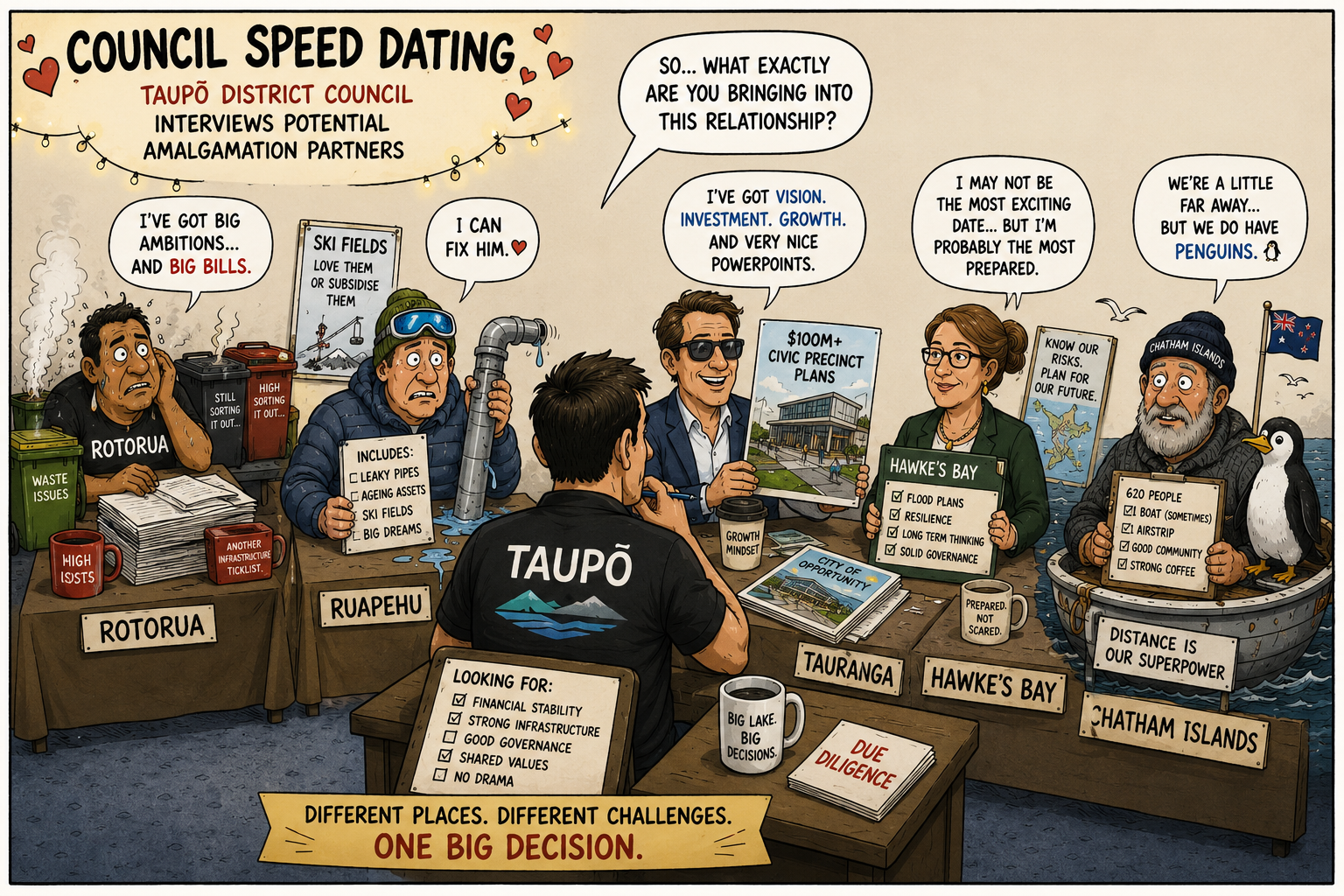
A look into debt, governance, infrastructure pressure, and which councils actually stack up.

( Nb: This article might be long.
Not because I hate you.
But because once you fall into the local government rabbit hole, you quickly end up buried in PDFs, infrastructure debt, and somehow… penguins. )
I’ve written about amalgamation before, but this time I wanted to do something different.
Instead of reacting emotionally, I decided to actually look at the councils potentially sitting around the table:
- their debt,
- staffing,
- infrastructure pressure,
- governance structure,
- and whether merging with them would genuinely benefit Taupō ratepayers… or simply spread the pain around more evenly.
And while digging through this, another question quietly appeared.
Taupō District Council has 13 elected members.
Yet when it came to discussions around regional collaboration and steering groups, we somehow landed on:
- one mayor,
- one deputy mayor,
- and four councillors.
Which naturally raises the question:
where exactly are the other seven?
Because if we’re talking about potentially reshaping the future structure of local government, representation probably matters more, not less.
So I did what any normal person absolutely shouldn’t do for fun.
I downloaded and compared annual reports from multiple councils between 2022 and 2025:
- Taupō,
- Rotorua,
- Ruapehu,
- South Waikato,
- Tauranga,
- Hawke’s Bay,
- and yes… even the Chatham Islands.
(Only because the rumour mill suggested the mayor had looked into it at one point… which honestly sounds mildly unhinged on several levels.)
I wanted to know:
- Which councils are financially stable?
- Which ones are drowning in infrastructure costs?
- Which appear strategically managed?
- Which are quietly surviving on government support and crossed fingers?
- And if amalgamation ever became real… who would Taupō actually benefit from aligning with?
Because “regional efficiency” sounds wonderful until you realise it may also mean:
- inheriting debt,
- absorbing failing infrastructure,
- losing local representation,
- or funding someone else’s problems through your rates bill.
And after reading several years of reports side-by-side, one thing became very clear:
New Zealand local government as a whole appears to be under enormous structural pressure.
Not just Taupō.
Not just Ruapehu.
Almost all of them.
Some councils looked surprisingly competent.
Some looked exhausted.
And one or two appeared to be operating entirely on resilience workshops and positive thinking.
First: What Even Is Amalgamation?
For those who don’t spend their evenings reading council governance structures while eating toast over the sink, amalgamation is essentially when councils combine into a larger governance structure.
That can involve:
- shared administration,
- merged infrastructure services,
- combined planning,
- regional decision-making,
- fewer elected representatives,
- and larger bureaucratic systems.
Supporters say it:
- reduces duplication,
- improves efficiency,
- strengthens infrastructure delivery,
- and creates economies of scale.
Critics say it:
- dilutes local voices,
- creates mega-bureaucracies,
- centralises power,
- and simply hides inefficiency inside larger organisations.
Or in plain English:
sometimes merging two struggling systems together doesn’t magically create a healthy one.
Sometimes it just creates a larger meeting agenda.
Taupō District Council — Growing Faster Than Its Systems?
Taupō sits in a strange middle ground.
It’s no longer a small rural district.
But it’s also not quite operating like a major city.
It’s:
- tourism-heavy,
- growth-focused,
- infrastructure-stretched,
- environmentally sensitive,
- and increasingly expensive to maintain.
The water infrastructure numbers alone are eye-watering.
Council’s own reports show replacement values of:
- $242 million for drinking water assets,
- $356 million for wastewater assets,
- $125 million for stormwater.
That’s over $700 million worth of underground infrastructure sitting beneath a district of roughly 41,000 people.
At the same time:
- rates continue rising,
- infrastructure upgrades continue expanding,
- wastewater capacity pressures are growing,
- and staffing numbers reportedly sit around 429 FTE.
That staffing figure becomes especially interesting once you compare it to other councils.
Because suddenly Taupō starts looking administratively very dense for its population size.
The district still projects confidence publicly.
Growth.
Opportunity.
Tourism.
Lifestyle.
But underneath the surface, the infrastructure machine appears to be under significant pressure.
And that’s before even touching the civic building debates.
Marriage Material?
Potentially attractive financially and geographically.
But already carrying enough infrastructure stress that inheriting another struggling council could become dangerous very quickly.
Rotorua Lakes Council — The Stress Test
Rotorua’s reports read like a council openly operating under pressure, but at least admitting it.
High debt.
Major infrastructure spending.
Tourism reliance.
Housing strain.
Water pressure.
Social pressure.
But unlike some councils, Rotorua appears fairly candid about the scale of its problems.
It also has:
- serious regional infrastructure thinking,
- integrated planning,
- and systems-level governance structures.
Rotorua’s reports also highlighted the growing pressure councils face from constantly expanding responsibilities and rollouts.
Even relatively small policy changes — such as the city’s FOGO green-bin rollout — became politically contentious due to rising costs, reduced rubbish collection frequency, and wider concerns around affordability during a cost-of-living crisis.
At one point, the rollout was even reportedly affected by international supply-chain disruptions linked to overseas conflict.
Because apparently in 2026, even wheelie bins are geopolitically complicated.
But:
“What kind of local government system is actually sustainable for the next 30 years?”
The downside?
Debt sits around the hundreds of millions.
Governance complexity is high.
And the district already carries significant social and infrastructure burdens.
Rotorua feels less like:
“everything is fine.”
And more like:
“the engine is overheating but at least someone is watching the gauges.”
Marriage Material?
Useful as a comparison.
Possibly useful for shared regional systems.
But merging two infrastructure-heavy tourism districts together could create one very expensive headache.
Ruapehu District Council — Financially Fragile
Ruapehu’s reports were probably the most openly strained.
Tourism shocks.
The Chateau closure.
Infrastructure pressure.
Water compliance.
Debt growth.
Their audit even carried emphasis-of-matter language relating to water reform uncertainty.
That doesn’t mean corruption.
It means uncertainty serious enough for auditors to specifically flag.
The overall impression was not:
“corrupt council.”
It was:
“small district under severe long-term pressure.”
And honestly, that may be more concerning in the long run.
Because structurally weak councils don’t suddenly become healthy through optimism alone.
Marriage Material?
High risk.
Taupō could easily end up inheriting more burden than benefit.
South Waikato District Council — Surprisingly Honest
South Waikato’s reports were some of the most blunt.
They openly discussed:
- deprivation,
- unemployment,
- economic pressure,
- infrastructure constraints,
- and inability to sustain standalone water services.
That honesty actually made the reports feel more credible.
Unlike some councils that speak exclusively in polished strategy language, South Waikato more or less said:
“We cannot realistically do all this alone anymore.”
Which is probably why they joined wider regional water structures.
The district feels survival-focused rather than growth-focused.
Less:
“visionary urban transformation.”
More:
“how do we keep this functioning without crushing ratepayers?”
Marriage Material?
Possibly useful for shared services and water coordination.
But full amalgamation would likely bring major financial and infrastructure liabilities with it.
Tauranga City Council — The Rebuild Era
Tauranga was fascinating.
Unlike many councils still pretending growth might stop if everyone ignores it hard enough, Tauranga appears fully committed to operating like a future major city.
Its reports are:
- systems-focused,
- infrastructure-heavy,
- climate-aware,
- transport-oriented,
- and deeply tied to long-term urban planning.
But the spending is enormous.
Civic precincts.
Libraries.
Transport corridors.
Resilience projects.
Water upgrades.
It’s ambitious.
Strategic.
And expensive.
The key difference is that Tauranga appears to know exactly what it’s trying to become.
Taupō still feels caught between identities.
Marriage Material?
Strategically competent.
But likely too metro-focused and growth-heavy to truly align with Taupō’s identity long-term.
Hawke’s Bay Regional Council — Probably the Strongest Operator
Out of everything I reviewed, Hawke’s Bay probably looked the most structurally mature.
Especially post-Gabrielle.
The reports focused heavily on:
- resilience,
- flood protection,
- regional systems,
- infrastructure coordination,
- measurable outcomes,
- and long-term risk management.
It felt less political.
More operational.
Less:
“brand messaging.”
More:
“keep the region alive during catastrophic weather events.”
That’s a very different governance culture.
The downside is that Hawke’s Bay also operates with:
- significant governance layering,
- large programme delivery costs,
- and deeply embedded co-governance structures.
But overall, it appeared one of the most strategically coherent councils reviewed.
Marriage Material?
Probably the strongest regional operator examined so far.
But perhaps better suited to shared regional infrastructure and resilience partnerships rather than full political amalgamation.
BUT
The biggest caution with Hawke’s Bay, however, may be affordability.
While the region appears operationally mature and strategically coordinated, parts of Hawke’s Bay have also experienced significant pressure around commercial rates, infrastructure recovery costs, and post-cyclone resilience spending.
And that matters.
Because Taupō ratepayers are already dealing with:
rising rates,
growing infrastructure obligations,
wastewater upgrades,
and long-term debt pressures of their own.
So while Hawke’s Bay may appear one of the stronger operators structurally, the question becomes: would aligning with a larger, resilience-heavy regional system actually reduce costs for Taupō… or simply plug Taupō into another expensive long-term infrastructure machine?
That’s the difficult balance with amalgamation.
The “best-run” systems are not always the cheapest systems.
Chatham Islands Council — The Wild Card
The Chathams are honestly their own category.
About 620 residents.
Extreme isolation.
Unique logistical challenges.
Heavy dependence on government support.
And yes, I only looked into them because the rumour mill suggested Taupō’s mayor had at least glanced in their direction at one point.
Which raises several logistical questions.
For context, the Chatham Islands sit around 800km east of mainland New Zealand.
Which means at some stage, someone apparently looked at an inland volcanic lake district in the central North Island and thought:
“You know what this needs? More ocean.”
At that point, amalgamation starts sounding less like strategic reform and more like someone lost control of the scroll wheel on Google Maps.
Reading their annual reports felt less like standard local government and more like:
“How do we maintain civilisation in the middle of the Pacific with six contractors, a barge schedule, and sheer determination?”
The council itself openly acknowledges that it cannot realistically meet statutory obligations without Crown support.
Which, frankly, is understandable.
But from an amalgamation perspective?
No.
Absolutely not.
Interesting case study.
Terrible structural match.
Marriage Material?
The council equivalent of trying to merge your household budget with a fishing boat during a storm.
So… Who Actually Stacks Up?
After comparing multiple annual reports between 2022 and 2025, my honest conclusion is this:
The future probably isn’t one giant super-council.
It’s probably:
- shared services,
- regional procurement,
- specialist staff sharing,
- coordinated water systems,
- emergency management integration,
- and infrastructure alliances.
Because once councils amalgamate fully, reversing it becomes almost impossible.
And bigger councils do not automatically become better councils.
Sometimes they just become larger bureaucracies with improved logo design.
The deeper issue appears to be this:
Modern infrastructure expectations have become so expensive that small and mid-sized councils are struggling to keep up independently.
That pressure is showing up almost everywhere:
- debt,
- water reform,
- staffing expansion,
- climate resilience,
- compliance overload,
- consultant dependence,
- and rising rates.
The reports themselves quietly tell the story.
And perhaps that’s the real question Taupō should be asking.
Not:
“Who can we merge with?”
Because if we get that wrong, the future won’t just be expensive.
It’ll be very difficult to unmerge later.

The Part Nobody Talks About: Unmerging
One thing that became very clear while researching all of this:
amalgamation is relatively easy to propose.
Un-amalgamating?
That’s a completely different story.
Once councils merge, you’re dealing with:
- shared debt,
- merged infrastructure,
- staffing integration,
- asset ownership,
- rating systems,
- legal structures,
- representation models,
- contracts,
- water systems,
- and governance legislation.
In other words:
once the eggs are scrambled, putting them back into separate shells becomes extremely difficult.
Even internationally, large council mergers often become politically permanent simply because reversing them would be:
- expensive,
- legally messy,
- administratively chaotic,
- and deeply unpopular with whichever side believes they’re financially carrying the other.
Which is why the conversation matters now, before anything becomes structural.
Because local government reform doesn’t just affect spreadsheets.
It affects representation, identity, local control, and who ultimately pays for whose infrastructure decisions over the next several decades.
Sources & Documents Reviewed
The following annual reports, planning documents, audit summaries, infrastructure reports, and public council material were reviewed while researching this article:
- Taupō District Council Annual Reports and infrastructure planning documents (2022–2025)
- Rotorua Lakes Council Annual Reports (2022–2025)
- Ruapehu District Council Annual Reports (2022–2025)
- South Waikato District Council Annual Reports (2022–2025)
- Tauranga City Council Annual Reports (2022–2025)
- Hawke’s Bay Regional Council Annual Reports (2022–2025)
- Chatham Islands Council Annual Reports (2022–2025)
- Development Contributions Policies
- Long Term Plans (LTPs)
- Annual Plans
- Audit opinions and infrastructure disclosures
- Water infrastructure and wastewater planning documents
- Public council agendas and governance material
- Publicly available media reporting relating to local government reform, infrastructure, and waste management initiatives
This article reflects personal analysis and commentary based on publicly available documents and reporting.
- Election 2026: Does Any of This Actually Add Up?

- Opinion : How to Lose the Room in One Easy Lesson

- 10 Questions: Election 2026 : Part Two: Chris Flatt, Labour Party

- 10 Questions: Election 2026 : Part Three: Opportunity Party, Sam Plummer.
- 10 Questions: Election 2026 : Part One: Louise Upston, National Party


Leave a Reply