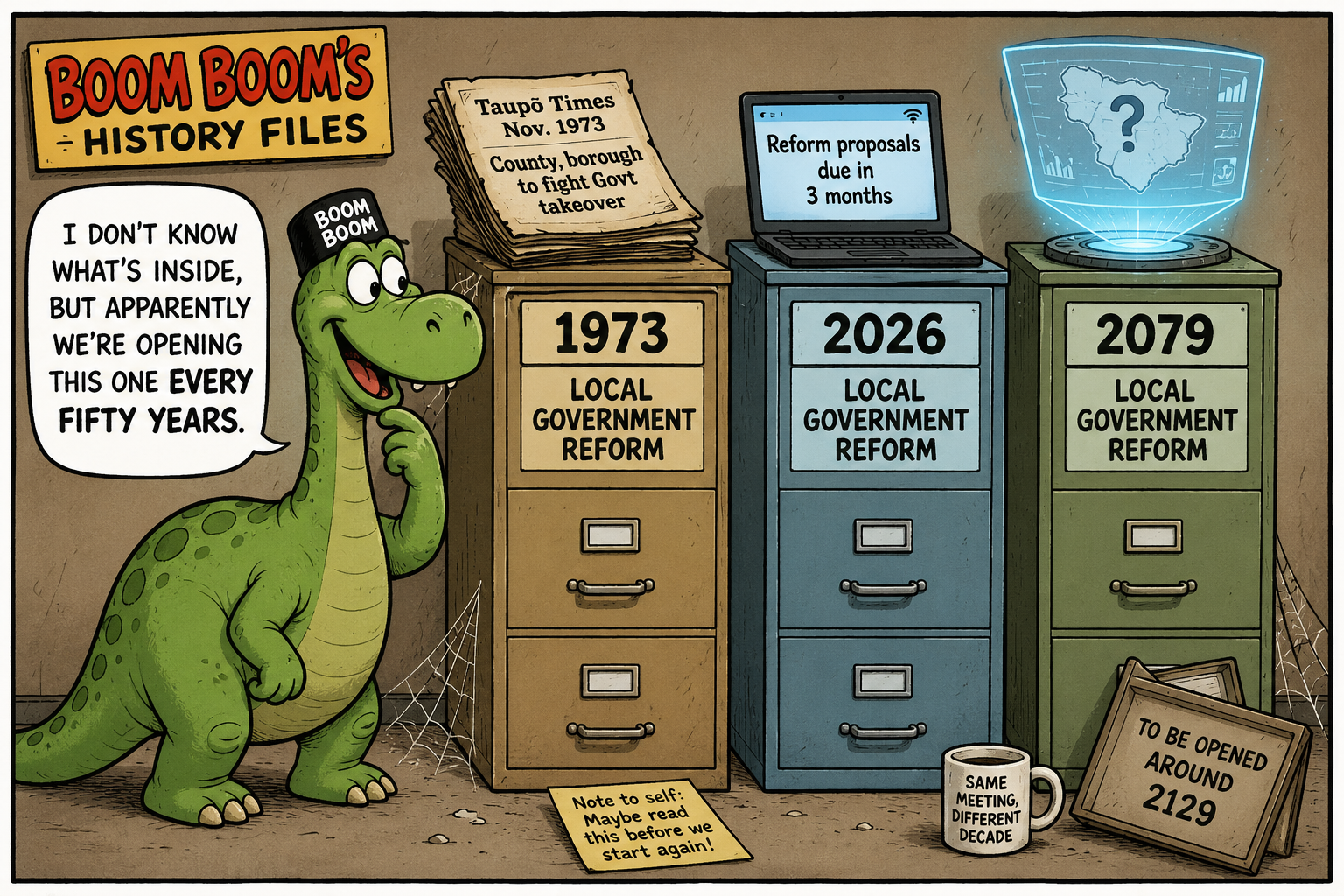
While researching Taupō’s history recently, I accidentally fell down another newspaper rabbit hole.
This time I emerged holding a copy of the Taupō Times from November 1973.
The headline immediately caught my attention:
“County, Borough to Fight Govt Takeover.”
At first, I assumed it must be referring to some long-forgotten political dispute from another era.
Then I started reading.
And reading...
And then I had that strange feeling you get when you realise history may have quietly dusted itself off and wandered back into the room.
Because the concerns being raised in 1973 sounded remarkably familiar.
Back then, local government reform was once again on the table. There were discussions about regional structures, local representation, where decisions would be made, and whether Taupō should be absorbed into something larger.
Sound familiar?
Fifty-three years later, Taupō is once again discussing local government reform.
We are once again debating local representation.
We are once again discussing amalgamation.
And we are once again asking who should be making decisions that affect our district.
The names have changed.
The politicians have changed.
The linotype machines are long gone.
Yet somehow, the conversation remains largely the same.
A Debate That Refuses To Die
What makes the 1973 article particularly interesting is that Taupō leaders were concerned about losing local control.
They worried that decisions affecting Taupō could end up being made elsewhere.
They argued that Taupō was unique.
They questioned whether larger structures would actually serve local communities better.
Fast forward to 2026 and many of the same questions are being asked again.
Which raises an awkward question.
If we have been debating versions of this issue for more than half a century, are we solving a problem, or simply redesigning the same map every generation?
The Three-Month Question
One thing that has puzzled me throughout the current reform discussion is the timeframe.
Councils have effectively been given a relatively short period to put forward proposals about the future shape of local government.
This is not a discussion about moving a bus stop.
This is not a discussion about where to place a rubbish bin.
This is potentially one of the biggest governance decisions local communities could face.
We are talking about representation.
Assets.
Infrastructure.
Rates.
Community identity.
Governance structures.
And relationships that could last for decades.
Yet communities are expected to consider all of this within a matter of months.
Perhaps there are good reasons for the timeframe.
Perhaps the Government believes reform is urgent.
Perhaps there are issues that genuinely need addressing.
But if these decisions are as important as we are being told they are, it seems reasonable to ask whether enough time has been provided for proper public discussion.
After all, many of us take longer than three months to decide whether to buy a second-hand ute.
The Political Timing
Of course, there is another factor that many people cannot help noticing.
It is election year.
That does not automatically make the reform wrong.
Governments still have jobs to do during election years.
But it does raise questions.
Will the next Government continue down the same path?
Will any proposals survive unchanged?
Will councils spend time and money preparing for reforms that may later be modified, delayed, or abandoned?
Nobody knows.
And uncertainty tends to make people nervous.
Particularly when rates notices are involved.
From Separation To Consolidation
What I found particularly interesting was the broader historical context.
In the decades before major local government reforms, New Zealand had a patchwork of borough councils, county councils, harbour boards, catchment authorities, drainage boards, and a collection of other local bodies.
The argument from Government was that there were too many separate entities and that the system needed simplifying.
Over time, many of those organisations were merged, reorganised, or absorbed into larger structures.
Now, decades later, we find ourselves discussing whether councils should become larger still.
From the perspective of an ordinary resident, it can sometimes feel as though local government spends a great deal of time rearranging itself.
One generation is told the answer is consolidation.
The next generation is told the answer is restructuring.
The generation after that is told the answer is another round of reform.
At some point, people are entitled to ask:
What problem are we trying to solve, and how will we know if we have actually solved it?
A Familiar Feeling
What struck me most was not whether amalgamation is good or bad.
Reasonable people can disagree on that.
What struck me was the familiarity of the debate itself.
In 1973, Taupō was asking:
“Will we lose local control?”
In 2026, Taupō is asking:
“Will we lose local control?”
In 1973, people worried decisions would be made further away.
In 2026, people worry decisions will be made further away.
In 1973, Government was redrawing local government structures.
In 2026, Government is once again considering how those structures should look.
At some point, you begin to wonder whether Wellington simply has a filing cabinet labelled:
“Local Government Reform. Open Every Fifty Years.”
Final Thoughts
I do not pretend to have all the answers.
The current system is not perfect.
No system ever is.
But when I read a newspaper article from 1973 and find many of the same concerns being discussed in 2026, it does make me pause.
Perhaps history is not repeating itself.
Perhaps it is simply reminding us that every generation eventually ends up debating the same question:
How much local control are we willing to trade in exchange for the promise of greater efficiency?
The answer may be different for every community.
But before we redraw maps, merge councils, or create new governance structures, it is probably worth making sure we are solving tomorrow’s problems and not simply having the same argument our grandparents were having half a century ago.
Because if Taupō is still discussing this in 2079, I suspect somebody will be sitting in front of a holographic newspaper saying:
“Hang on a minute. Haven’t we had this conversation before?” :::


Leave a Reply