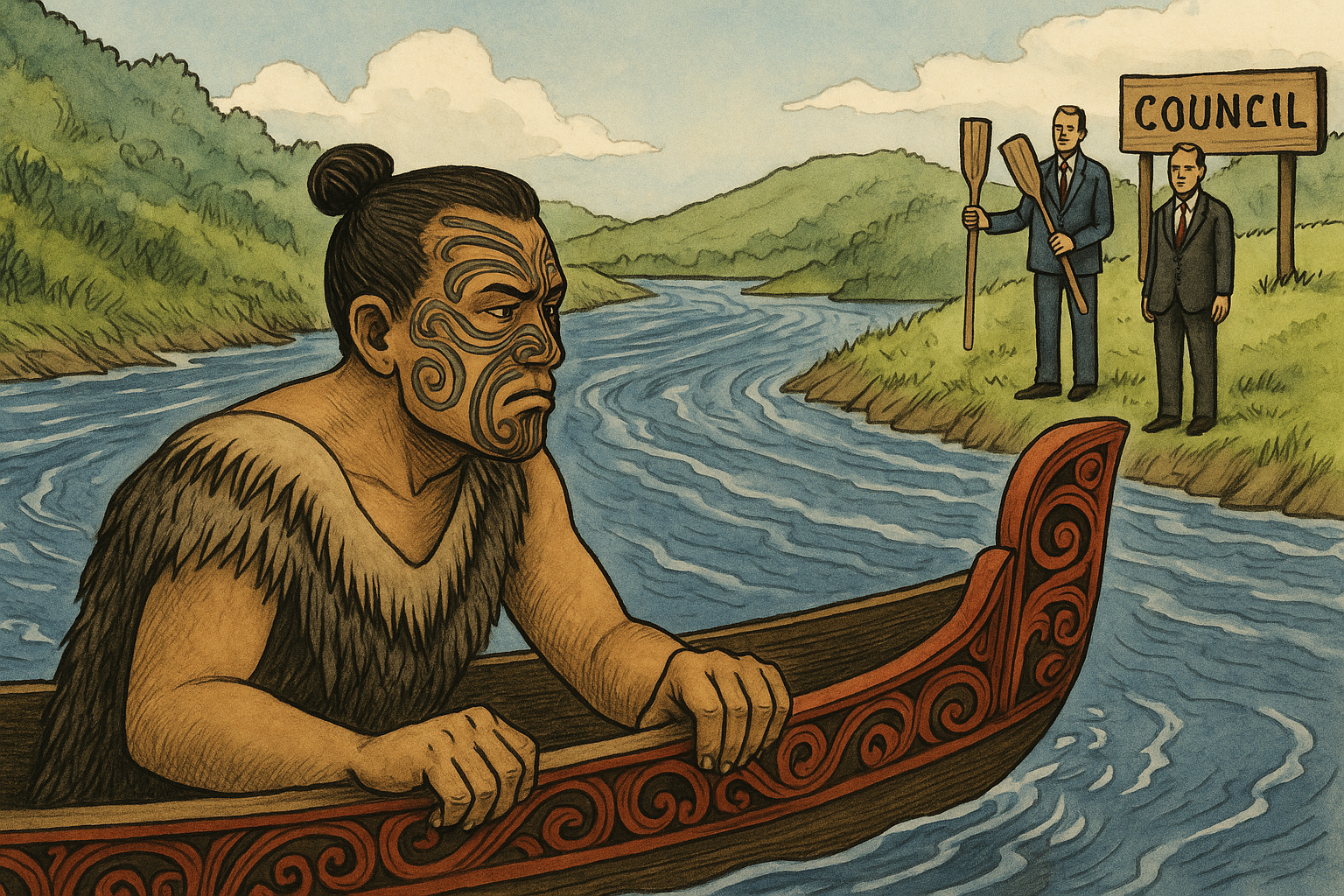
A personal reflection on Te Tiriti, fairness, and unlearning
Author’s note:
This piece includes personal reflections and historical references. I’ve done my best to get things right, and I’m open to correction if anything needs improving.
Where I Came From
I was born on the south coast of England, and I moved to Aotearoa when I was two. I grew up here. Most of my life has been in South Auckland, in Manurewa, surrounded by Māori and Pasifika culture. I spent five years in Waikanae, where iwi presence was part of daily life. I thought I understood Māori culture.
When I moved to Taupō, I did not realise what I was stepping into. This place carries a different kind of weight. There is mana in the whenua. There is silence where injustice lives. There are stories under the lake that nobody put in a schoolbook.
My Whakapapa
A simple DNA test surprised me. I am roughly 46 percent English and Northwestern European, 30 percent Scottish, and 11 percent Welsh, with small traces from elsewhere. I always identified more strongly with the Scottish and Welsh parts. As I read more history, I understood why. The empire that came here was first practised there. The Highland Clearances, the suppression of Welsh and Gaelic languages, and the erasure of local lifeways were not distant events. My ancestors lived inside that pressure. I do not carry only coloniser blood. I also carry colonised blood.
The Treaty They Did Not Teach Us
At school, we visited Waitangi and learned a tidy version of events. Only later did I learn that there are two texts. Te Tiriti o Waitangi is the Māori text. The English text is different. Te Tiriti used words with deep relational meanings. Kāwanatanga describes governance. Tino rangatiratanga promises the unqualified exercise of chieftainship over lands, people, and treasures. These meanings are not the same as the claims made in the English text. That difference matters and it shaped everything that followed. NZHistory+2Te Papa+2
The Chief Who Said No
Here is the part I was never taught. Ngāti Tūwharetoa did not accept the Treaty in the way the Crown later claimed. Iwikau Te Heuheu travelled to Waitangi and signed on 6 February 1840, but he did not have authority to commit the iwi. His brother, the paramount chief Mananui Te Heuheu Tūkino II, repudiated that action. NZHistory
When Crown officials brought the Treaty to Ōhinemutu for further signing, Mananui stood before them and rejected the Queen’s authority on behalf of his people. The Crown’s own settlement record preserves the wording that is commonly quoted. I will include only the essential lines here in Māori, followed by a paraphrase in English.
“Kāore rawa au e whakaae ki te mana o tērā wahine iwi kē … ko au anō hei rangatira mō ēnei motu.”
He refused the authority of the Queen and affirmed his own chiefly authority over these islands. He finished by instructing them to stand and go.
The Crown has formally acknowledged that Mananui refused to sign and that Tūwharetoa grievances were legitimate. Government of New Zealand+1
Sandwiches and Settlements
People often say that Māori received settlements and that the matter is closed. That is not how it feels on the ground. Much of what was taken has never been returned. What was returned was often a fraction of the loss and arrived generations late. In many places, land that is returned is still subject to council zoning, consents, and shared boards that limit real authority.
In the Taupō context, the bed of Lake Taupō and related waterways is held in Māori freehold title by the Tūwharetoa Māori Trust Board under deeds with the Crown. Public access and Crown regulatory powers remain part of the arrangement, and management plans and joint management agreements set important boundaries on how authority is exercised. Ownership exists, yet oversight remains. Waikato Regional Council+3tuwharetoa.co.nz+3assets.maorilawreview.co.nz+3
Update on the Lake and Tributaries (Correction & Clarification)
It is my understanding that the Tūwharetoa Settlement is an ongoing process, and that this is completely separate to the ownership of Lake Taupō and its tributaries.
The Crown took ownership of the lakebed and rivers approximately 100 years ago, and returned the lakebed in 1992. The tributaries were returned in 2007, although some still remain in other hands.
The Tūwharetoa Māori Trust Board is the fee simple title owner of these taonga. They share access to the lake and waterways freely with the public, including for swimming, boating, and fishing. That generosity is not always acknowledged, and it is worth naming.
This update is based on conversations with locals and verified public information. I am including it because getting it right matters, especially when speaking about mana whenua and taonga tuku iho.
The Rates Myth, Explained
Another common claim is that Māori land does not pay rates. The reality is more nuanced. Māori freehold land is rateable under the Local Government (Rating) Act 2002 unless it falls under an exception or a council grants remission or postponement under policy. Recent legislative changes were designed to remove barriers and to support practical use and development. In short, rates may be remitted or postponed in specific circumstances, but there is no blanket exemption for all Māori land. Gisborne District Council+1
What I Was Taught, And What I Know Now
I was taught to feel uncomfortable about Māori aspirations. I was not taught the full historical context that would make those aspirations obvious and reasonable. I can see now that governments tell stories that support their own legitimacy. That is not a statement of hatred toward government. It is an observation about how states work. We were given a simplified version of events that made Māori look demanding and the Crown look generous.
The truth is simpler and harder. Māori are not taking anything from us. In reality, it was never ours to begin with.
A Conversation That Stayed With Me
Someone said to me that the Crown gave Māori lemons and Māori learned to make lemonade. Now some people do not like the taste. That line has stayed with me because I can see it in community life. Māori have raised whānau, cared for whenua, and kept language and culture alive through generations of pressure. When some authority or land is finally restored, they are accused of asking for too much. They are not taking. They are rebuilding.
Please Hear This
I am not claiming to know everything. I am still unlearning. I have said things that were wrong. I have held views that came from fear and from a poor education. I am sorry.
I understand why iwi are angry. It was not fair. The document alone cannot repair that, and neither can the Crown on its own. Honesty can begin the repair. Listening can move us forward. Real apology can open the door.
I will keep learning. I will not stay silent.
Sources/ Further Reading:
Trust Board Declaratory Judgment & property rights
The Trust Board’s site contains the declaratory judgment confirming full ownership rights and power to manage Taupō Waters.
tuwharetoa.co.nz
Ngāti Tūwharetoa Deed of Settlement & Crown apology
“Deed of Settlement with Ngāti Tūwharetoa” — details on the historical redress, Crown acknowledgements, cultural and financial redress.
The Beehive
Te Tiriti / Treaty Settlements site — Ngāti Tūwharetoa overview
Provides background, lists of sites to be vested, and settlement details.
Whakatau+1
Iwikau Te Heuheu signing and lack of authority
Entry on NZHistory that notes Iwikau Te Heuheu signed the Treaty but without the authority of Ngāti Tūwharetoa, and that his brother Mananui disowned it.
NZHistory
Mananui Te Heuheu biography (Te Ara)
Provides context about Mananui’s leadership, his genealogy, and historical role.
Te Ara
Taupō Waters ownership & Trust Board rights (High Court / legal rulings)
The High Court affirmed that Ngāti Tūwharetoa can require license and charge commercial users on Lake Taupō. tuwharetoa.co.nz+2simpsongrierson.com+2
The 2007 deed confirms that the Tūwharetoa Māori Trust Board owns the bed of Lake Taupō as Māori freehold land. tuwharetoa.co.nz+3Doc.govt.nz+3tuwharetoa.co.nz+3
Joint Management Agreement – Taupō District Council & Tūwharetoa Māori Trust Board
Details about collaboration and shared responsibilities over waterways in Taupō and Upper Waikato.
taupodc.govt.nz
Ngāti Tūwharetoa Claims Settlement Act 2018
The Act that gives legal force to the Deed’s provisions, including vesting, rights, and redress.
New Zealand Legislation


Leave a Reply