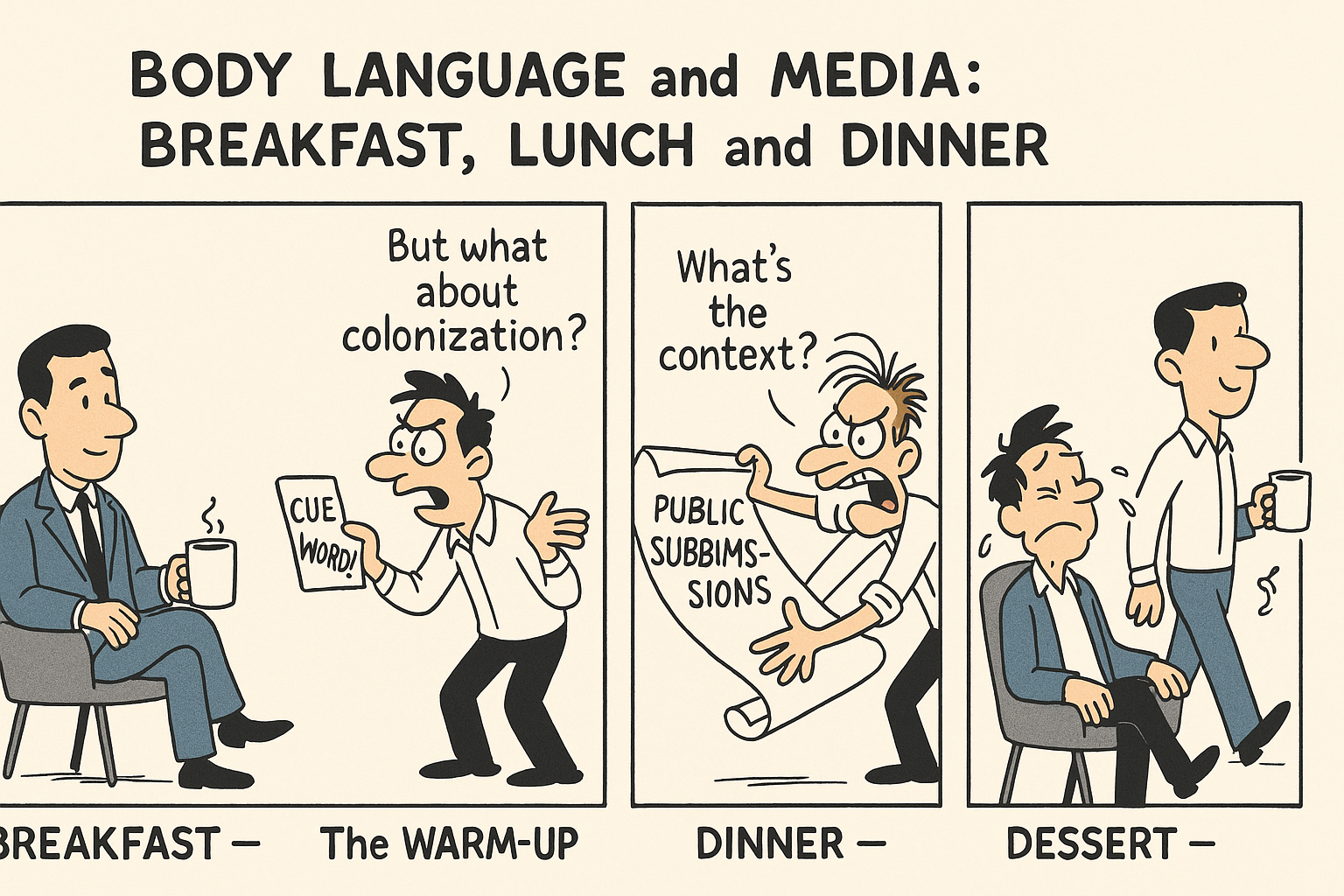
I know this sounds a bit off-topic, but I stumbled across a gem while trawling through ACT’s YouTube channel. And here’s the truth: I don’t watch their videos because I’m obsessed with David Seymour. I watch them because they’re interesting in a different way — they show how the media sometimes Rick-roll him. The papers cut him down with headlines and snappy edits, but the raw footage tells another story. That gap is where it gets fascinating — not for his sake, but for ours.
Part One: Breakfast (the warm-up)
The Seymour–Campbell interview is a perfect example. Most people only saw the clipped version on the news, where Campbell came across as sharp and relentless. I watched the whole thing — from the pre-interview banter to the awkward goodbye — and breakfast was already telling.
Campbell opened with the so-called “C-word” surprise, teasing Seymour about what his team might have called him. Seymour brushed it off calmly. Campbell, on the other hand, tightened up — his voice pitched higher, his body leaned in. Before the first policy question was asked, the roles were already reversed: the politician looked relaxed, the journalist looked rattled.
Part One: Breakfast (the warm-up)
The Seymour–Campbell interview is a perfect example. Most people only saw the clipped version on the news, where Campbell came across as sharp and relentless. I watched the whole thing — from the pre-interview banter to the awkward goodbye — and breakfast was already telling.
Campbell opened with the so-called “C-word” surprise, teasing Seymour about what his team might have called him. Seymour brushed it off calmly. Campbell, on the other hand, tightened up — his voice pitched higher, his body leaned in. Before the first policy question was asked, the roles were already reversed: the politician looked relaxed, the journalist looked rattled.
Seymour sat back, relaxed, modest in his gestures. Campbell, meanwhile, crossed his legs knee-over-knee, chin propped on his hand like a philosopher waiting for the right punch. Then came the mirroring — Campbell unconsciously copying Seymour’s small gestures, as if trying to reassert control. Breakfast was light, but you could already taste the tension.
Part Two: Lunch (the main course)
Then came twenty minutes of circling. Campbell pressed the same questions again and again, particularly around Māori life expectancy and colonisation. Seymour stayed calm, sometimes exasperated, sometimes faintly amused, but never rattled.
The irony? Seymour had just mentioned reading Never Split the Difference, a hostage negotiator’s manual. And yet in this interview, it was Campbell who behaved like the hostage-taker — leaning in, tilting his head sideways, voice sharp, trying to pin Seymour down.
But the rope never moved. Seymour didn’t dodge, didn’t panic, didn’t do the usual politician’s sidestep. He repeated his answers steadily. By the halfway mark, the pattern was clear: Campbell circling, Seymour steady. Lunch was heavy, but it was the same dish served over and over.
Part Three: Dinner (the heavy serving)
The patronising tone crept in next. Campbell turned to public submissions on the Treaty Principles Bill and regulatory standards, cherry-picking quotes as though they represented “the public.” Seymour’s reply was calm: “What’s the context?”
And then he explained it in his own way — mass email campaigns, orchestrated submissions, the difference between spam and carefully argued opposition. Campbell grew dismissive. Seymour pivoted outward: “Let’s see what the public are saying.” It was clever. Instead of fighting Campbell’s framing, he handed the judgement back to the audience.
In that moment, the balance flipped. Campbell looked closed. Seymour looked open. Dinner was a heavy serving, and this time it was the journalist, not the politician, who seemed weighed down by it.
Part Four: Dessert (the aftertaste)
I’d never really studied Campbell’s interview style in detail. Sometimes his interruptions look passionate. Other times they look plain rude. In a clipped highlight, he might have looked strong — holding Seymour to account. But in the full, unedited version, the cracks showed: the circling questions, the head tilts, the cupped hands on his leg, the cherry-picked quotes.
Seymour, for all his quirks, stayed calm. He didn’t dodge; he held his ground without theatrics. And that’s what made the contrast so striking.
The interview was served to the public as a sharp entrée. Watched unedited, it became the full three-course meal — body language for breakfast, circling for lunch, cherry-picking for dinner. And the aftertaste? That maybe our media need context as much as our politicians do.
End piece:
It’s almost like a reverse Rickroll. The media bait you in, promising the big scandalous chorus. But when you watch the full cut, there’s no song and dance — just a politician staying calm while the journalist circles the floor. It’s not catchy, it’s not scandalous, and that’s the point. The context kills the punchline.
watch the full video here :


Leave a Reply