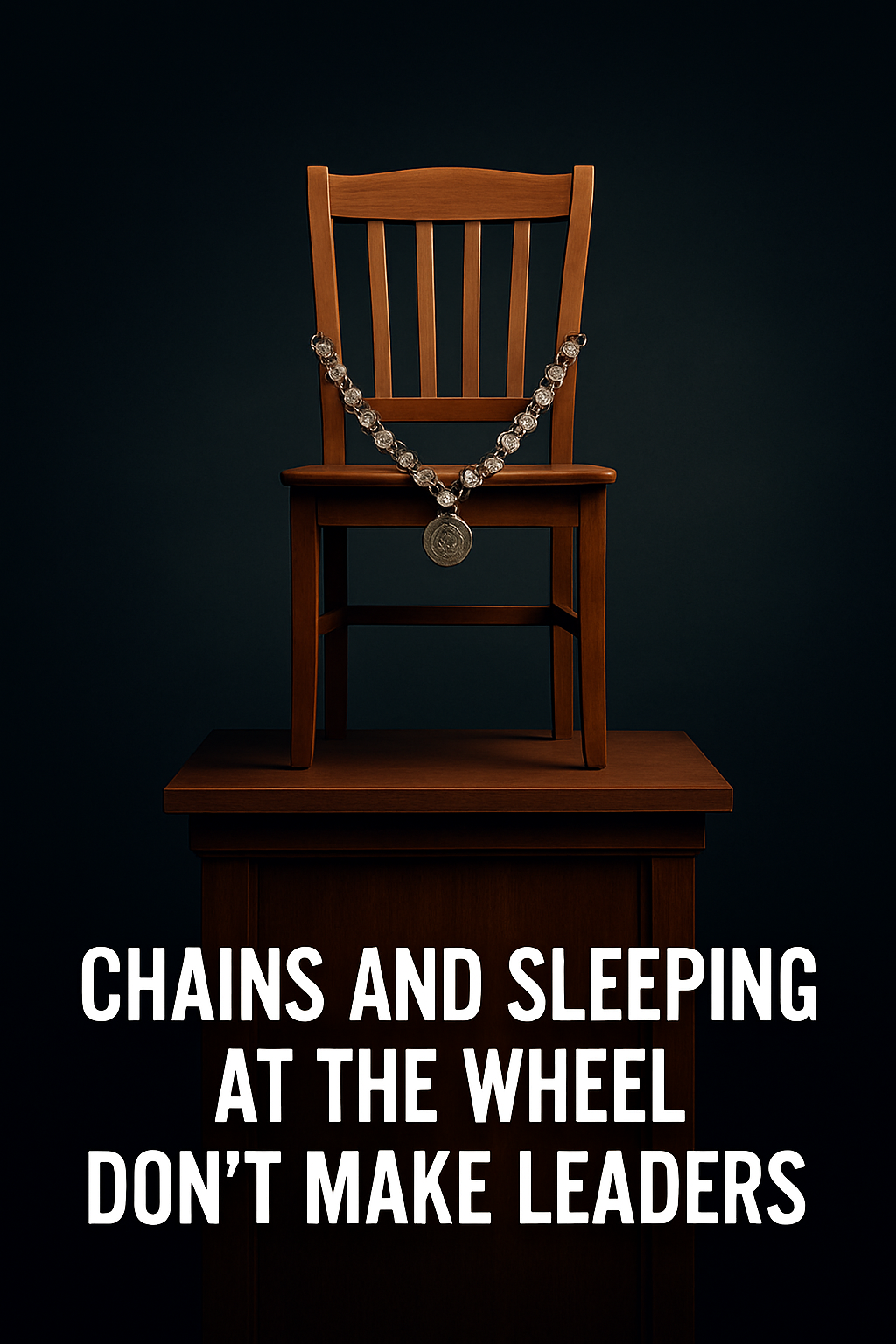
Reflections on the Mayor and Deputy in Taupō Council
I’ve always pondered what a true leader would look like. Not the textbook definition filled with buzzwords, but the real kind; the sort of leadership that leaves fingerprints on a community long after the speeches are done and the chairs are stacked away. And in Taupō, that question is even sharper: what should leadership look like when we’re talking about our mayor and deputy mayor? Because chains and sleeping at the wheel, don’t make leaders.
Leadership isn’t a badge
Leadership isn’t something you pin to your lapel, or a badge you get from Hey Duggee. It’s not automatically granted when you’re handed the mayoral chains or the deputy’s seat. Those are titles. Leadership is about how you use those roles.
Do you carry them with humility?
Do you listen before you talk?
Do you ask the hard questions even when it might cost you popularity?
Because at the end of the day, a mayor without humility is just a voice with a microphone, and a deputy without courage is just an empty chair waiting for instructions.
The mayor’s role
The mayor of Taupō is often seen as the face of the district, the one who shakes the hands, cuts the ribbons, and represents us on the bigger stage. But underneath the photo ops, the mayor has real responsibilities:
- Setting the tone: chairing meetings, guiding debates, and holding a vision for the district.
- Frontline representation: whether it’s with central government or iwi, the mayor is the first voice people hear.
- Crisis captain: when there’s a flood, a fire, or a pandemic, people look to the mayor first.
The real test? Whether a mayor can stand in those moments with clarity, not spin. Whether they can hold both vision and accountability without losing themselves in the glow of their own spotlight.
What to look for in a Mayor
What kind of character do we want in a mayor? It’s not an easy role, being the face of Taupō means carrying pressure from every direction. A mayor wears many hats: spokesperson, negotiator, crisis manager, meeting chair, and community champion, all in the same week. It’s not enough to just quote statistics or rattle off policy lines.
A good mayor needs long-standing business acumen; an understanding of the fundamentals of how money flows, how decisions ripple out, and how to balance vision with reality. But numbers alone don’t make a leader.
The mayor also needs empathy and kindness, the willingness to get down in the dirt and lift others up not just in the community, but within their own team of councillors. Those councillors aren’t obstacles. They’re elected representatives of the people, and they are the team the mayor must guide.
It’s not always about attention or getting credit. This is where humility pays a huge part in the role. A mayor who seeks the spotlight too much risks burning the very bridges they need to build.
Of course, every person we choose will come with flaws. That’s human nature. But kindness, humility, and resilience go a long way in shaping a leader who can carry both the weight of the role and the trust of the community.
And this is where the mayor and deputy tie together. One without the other is shaky. A mayor who leads with vision but has no grounding partner risks drifting. A deputy who steadies but doesn’t challenge risks becoming invisible. Together, though, they can form a balance: one steering the ship, the other keeping it on course.
The deputy’s role
The deputy mayor is often misunderstood; people think of them as a “mini-mayor” or simply the mayor’s right-hand. But in reality, the deputy is the balance point. They are meant to be a steadying voice in the chamber, someone who can carry the weight when the mayor is absent, and ideally, someone who challenges rather than flatters.
A good deputy doesn’t just nod along. They bring a different angle, sometimes uncomfortable truths, and they help keep the leadership team honest. It’s a role of quiet influence, not just ceremonial backup. And here’s the kicker: a deputy can either undermine the mayor, or keep them accountable. The difference comes down to character.
What to look for in a deputy mayor
If you were sitting in the mayor’s chair and had to choose a deputy, what qualities would you look for? It’s not just about political loyalty or convenience. A good deputy needs to be the kind of person who lifts the team rather than their own profile.
- Leadership skills and teamwork: not the loudest voice, but someone who knows how to guide, encourage, and give credit when it’s due. A deputy who hogs the limelight becomes a distraction.
- Likeability across the board: not in the sense of being a people-pleaser, but someone who can work well with everyone in the chamber, regardless of camp.
- Integrity: we throw this word around a lot, but how many actually live it? True integrity is doing the right thing when nobody’s watching — not just when the cameras are on.
- Humility and self-control: this isn’t weakness. It’s strength wrapped in grace. It’s knowing when to speak, when to stay silent, and how to disagree without tearing the house down.
In many ways, the qualities we should want in a deputy sound a lot like the fruit of the Spirit — patience, kindness, gentleness, self-control. Those aren’t soft virtues. They’re the backbone of a leader who can steady the ship in rough waters and remind everyone what the job is actually about: serving the community.
What we should expect
If Taupō is going to thrive, we need to expect more than titles. We need a mayor who can listen deeply and act decisively, and a deputy who can hold the line when politics gets murky. Leadership should look less like power and more like stewardship. Less about personal legacy, more about building resilience in the community they serve.
The hard truth? Leadership in council should never be about ego. It should be about leaving the place better than you found it.
And maybe the question we need to keep asking, every election, isn’t just who will be mayor or deputy, but what kind of leadership are we really voting for?
Disclaimer: This post reflects personal reflections on leadership in the context of Taupō District Council. It is not an endorsement of any specific candidate, but an exploration of the qualities we should expect from those who seek to lead our community.
If you’ve laughed, sighed, or rage-nodded your way through this post, consider shouting me a hot chocolate (or two). It’s fuel for more council chaos coverage, political roast recaps, and keeping things just the right amount of spicy.
Because democracy is tiring… and I write better when I’m warm and mildly caffeinated.
Make a one-time donation
Make a monthly donation
Make a yearly donation
Choose an amount
Or enter a custom amount
Your contribution is appreciated.
Your contribution is appreciated.
Your contribution is appreciated.

Leave a Reply