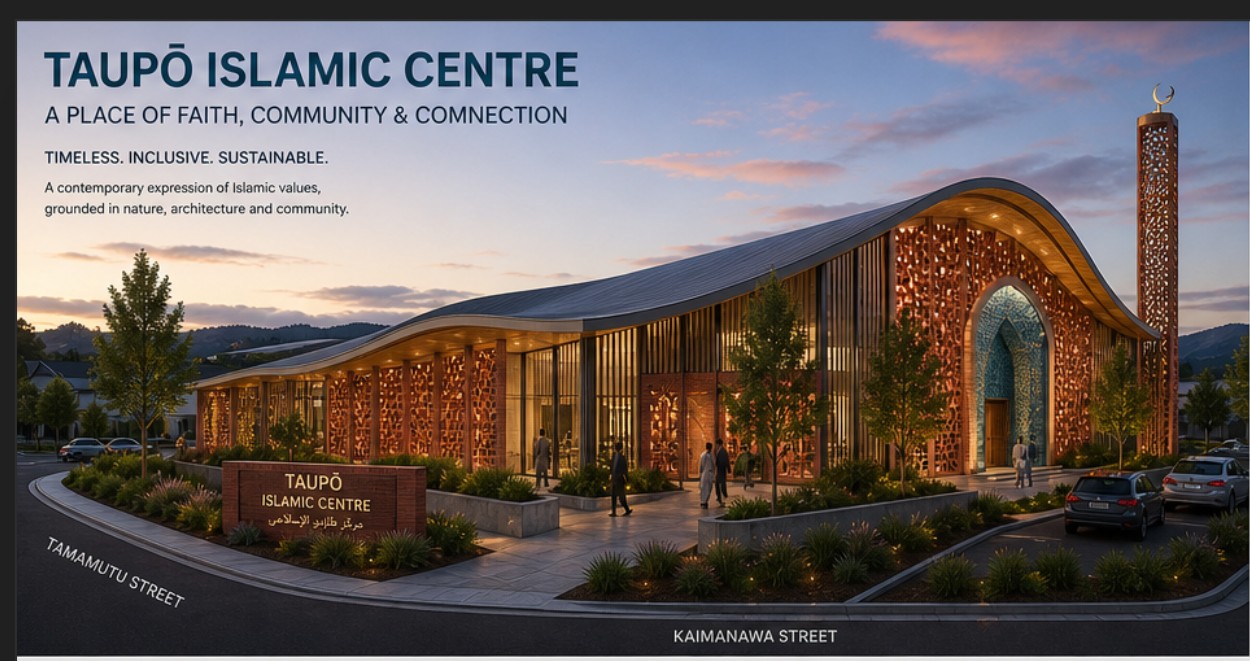
There’s something I’ve been sitting on for a bit.
I’m not opposed to what’s being proposed — I’m still divided on it
but I wanted to understand it properly before saying anything.
After going through the plans, looking at the site, and comparing it to other projects, I keep coming back to the same feeling:
This isn’t about whether the building should exist.
It’s about whether we’ve designed it well enough for what it represents.
A Building Like This Carries More Weight
Spaces like this aren’t just functional.
They hold:
- community
- identity
- belief
- and a sense of belonging
And whether we realise it or not, people read that through design.
Not through labels.
Not through explanations.
Through what they see and how it feels.
What I Saw in the Plans
When I looked at the layout, the first thing that stood out wasn’t anything dramatic.
It was how… ordinary it felt.
A corridor.
Rooms branching off.
A prayer space sitting at the end.
It works. It functions.
But it reads more like a collection of spaces than a considered experience.
There’s no real sense of:
- transition
- preparation
- arrival
And for a space that’s meant to hold meaning, that matters.


The Journey That’s Missing
In many well-designed religious buildings, you don’t just walk in.
You move through a sequence.
Outside.
A moment of pause.
A shift in atmosphere.
Then the main space.
That transition prepares you mentally, physically, spiritually.
Here, it feels more like:
you walk in… and you’re just there.
No shift.
No moment.
Just function.
Ablution — More Than Just Washing

One of the most powerful parts of many mosque designs isn’t even the prayer space.
It’s the ablution area.
It’s where people wash before entering — hands, face, feet.
But in good design, it’s not hidden away like a utility room.
It’s calm.
Ordered.
Deliberate.
It slows you down.
It becomes part of the experience.
In the plan I saw, it’s there, which is important
but it feels secondary.
Tucked in, rather than designed.
What Good Design Looks Like (Even on a Small Site)


The Cambridge Central Mosque [England] sits in a busy, built-up town.
It doesn’t dominate its surroundings.
It doesn’t rely on traditional forms to be understood.
Instead, it works differently.
Light filters through.
Timber structures branch like trees.
Rainwater is collected and reused.
The building breathes.
It feels grounded, calm, intentional.
Not because it’s big, but because it’s thought through.
A Different Approach — Punchbowl


Punchbowl Mosque in Sydney serves a community of around 20,000 people.
From the outside, it’s not what you’d call “pretty.”
But inside, it’s one of the most considered spaces you’ll come across.
Light drops through the ceiling.
Concrete shapes space quietly.
Ablution becomes part of the journey, not an afterthought.
It wasn’t designed to imitate tradition.
It was designed to understand the experience.
Back to Taupō
This is where the question sits for me.
The proposed building works.
It fits on the site.
It ticks the boxes.
But it feels like it stops there.
The materials feel heavy.
The layout feels tight.
The landscape feels like what’s left over.
And on a site that’s only just over 1000sqm, every decision matters.
You can’t afford to waste space,
but you also can’t afford to waste opportunity.
It Doesn’t Need to Be Big , Just Intentional
I understand architecture is expensive.
Not every project can be ambitious or iconic.
But it doesn’t need to be.
Even small decisions can shift a building completely:
Because buildings like this don’t come along often.
- how light enters a room
- how materials feel
- how you move through space
- how the outside connects to the inside
Even colour and pattern, something I’ve worked with myself in design can carry meaning far beyond what’s on the surface.
You don’t need to shout.
But you do need to say something.
Why This Matters More Than We Think
We can argue about beliefs.
We can debate what should or shouldn’t be built.
But most of the time, that’s not where tension actually starts.
It starts when something feels unresolved.
When a building doesn’t quite explain itself.
When it doesn’t feel like it belongs.
When people are left to interpret it on their own.
Good design prevents that.
It communicates quietly.
It creates understanding before conflict ever has a chance.
A Final Thought
Taupō is a deeply spiritual place, however you choose to define that.
So it’s fair to ask:
Shouldn’t a building like this carry meaning?
Not just in what it is,
but in how it feels.
Right now, the design leans toward something traditional — but in doing so, it feels disconnected from the town it sits in.
Taupō has its own identity.
Its own landscape.
Its own sense of calm and presence.
A building like this could reflect that —
not by copying what’s been done elsewhere,
but by interpreting it through this place.
Because architecture at this level shouldn’t just function.
It should:
- move people
- use light intentionally
- use pattern with purpose
- use colour to create atmosphere
And Islamic architecture already does this beautifully.
We know it can.
So the question becomes:
Why isn’t that happening here?
Taupō deserves something that brings those elements together,
something that feels considered, grounded, and meaningful.
Because when it doesn’t,
people feel it.
And right now, that’s why it stands divided.
Good architecture doesn’t need to shout tradition to be understood.

A full design would include all required community and support spaces.


Sources
Project Documentation
- Taupō District Council property file (Kaimanawa Street site)
- Consent drawings and architectural plans
- Site measurements and planning information
Architectural References
- Cambridge Central Mosque, UK
https://cambridgecentralmosque.org/ - Punchbowl Mosque, Sydney
https://www.candalepas.com.au/projects/punchbowl-mosque
Design & Environmental Principles
- Passive design strategies (light, ventilation, shading)
- Rainwater harvesting and reuse systems
- Contemporary Islamic architectural approaches
Visual References
- Examples of modern mosque design (light, geometry, material use)
- Ablution space design examples
- Brick screen / perforated facade precedents
Concept Development (Author)
- Original concept sketches and design explorations included in this article
- Alternative layout and landscape proposals developed to test site potential
If this made you pause, even slightly —
you can shout me a hot chocolate ☕
I take on the uncomfortable conversations, not just in council, but across our town.
Make a one-time donation
Make a monthly donation
Make a yearly donation
Choose an amount
Or enter a custom amount
Your contribution is appreciated.
Your contribution is appreciated.
Your contribution is appreciated.


Leave a Reply