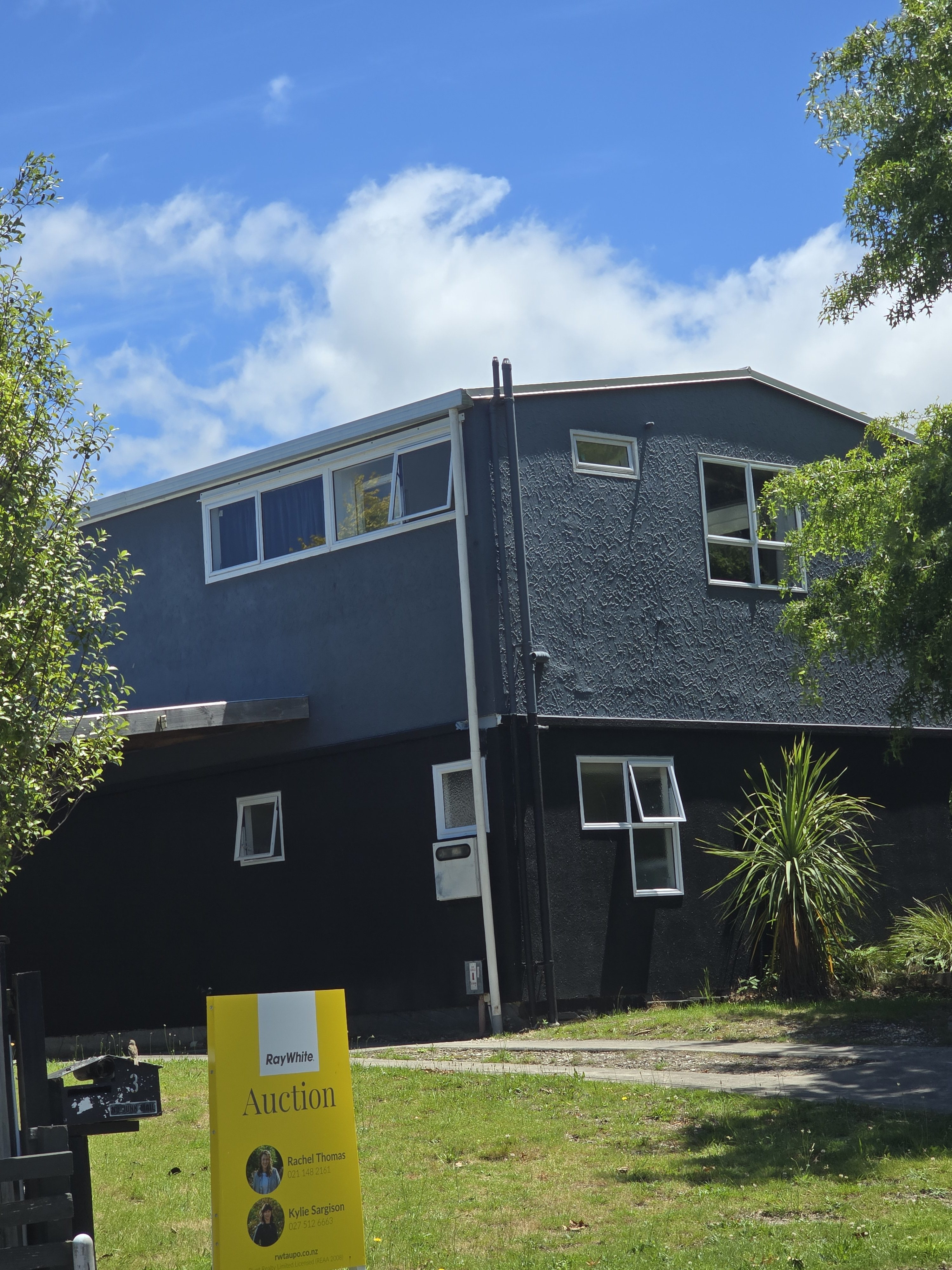
Every now and then, Taupō coughs up a house that makes you stop, squint, and think, “Hang on… where did that come from?”
3 Epping Place is one of those.
It sits quietly in Richmond Heights — a tired, misunderstood box that everyone assumes is just another dated 60s project home. But the truth is a lot stranger, and honestly, a lot more interesting.
This house wasn’t built here.
It wasn’t even meant to be a house.
And it absolutely wasn’t designed for suburbia.
It began its life behind the old Sacred Heart Church in Hastings.
Seriously.
First contact: something felt wrong
I first saw 3 Epping Place on Facebook in one of those basic real estate promotions. Five bedrooms, two bathrooms, two carports, auction on 17 December, open home 6th December at 11.30 am. Nothing unusual, except the building did not look like anything else in Richmond Heights.
It was too long. Too thin. Too institutional. The proportions were not residential. The windows looked like they belonged to a school or church building. Something about the whole form felt out of place.
So I ordered the property file.
The property file: what I missed the first time
The first time I skimmed it, I missed the important part. I focused on the consents and the neighbour objections and did not look closely at the attached photographs. I also missed the tiny Xerox images hidden near the back.
What did stand out immediately was a line in a letter dated 14 November 1990 from Noel and Ngaire Baker of Hastings to Taupō District Council.
“Used for accommodation at the Catholic Church, Hastings and can be described as a two storied timber framed building with iron roof, built on a concrete slab on ground floor and clad in stucco.”
So the “house” was not a house at all. It was a church building. A presbytery block. Two storeys. Timber framed. Stucco. Iron roof. Built on a slab.
The Bakers wanted to remove it from Heretaunga Street East in Hastings and place it on their new site at 3 Epping Place. They planned to use it as a holiday home and eventually live in it when they retired.
Taupō District Council did not support the idea at first.
Taupō Council says no.
On 23 November 1990, the Controlled Use Committee declined the relocation.
Their reasoning was blunt.
“The architectural style and design of the proposed dwelling is not compatible with properties in the adjacent neighbourhood and therefore in the council’s opinion, it would detract from the amenities of the neighbourhood.”
Translation. We do not like the way it looks.
The Bakers hired lawyers. Fletcher Housing supported them. Eventually, on 22 January 1991, the Council approved the relocation but only with strict conditions and a bond of at least twenty thousand dollars.
The Bakers had to completely recoat, reline and repaint the exterior. They had to change the windows. They had to add trellis. They had to landscape the entire front yard. They had to repaint the roof. They had to finish the exterior within six months. They had to finish the interior within twelve months.
This was not a gentle consent. It was a full forced makeover.
The Xerox photos that changed everything
On my second trip through the property file I slowed down and read every page. That is when I found them. The Xerox photos. Grainy black and white, but clear enough to recognise the long verandah, the balcony posts, the stair tower and the yard around it.
This was not Taupō.
It was Hastings.
And it sat behind a very specific church.
Old Hawke’s Bay steps in
I joined the “Old Hawke’s Bay” Facebook group and posted the Xerox images with a simple question. Does anyone remember this building.
The response was immediate.
It was part of the Sacred Heart complex on Heretaunga Street East. The big Gothic church. The school buildings. The presbytery rooms. The long two storey block behind the church that many people remembered walking past before the site changed.
At this point I had a likely location. I needed confirmation.
The aerial proof
I found old aerial photographs of Sacred Heart. The layout was unmistakable.
The Gothic church on the corner.
The long two storey block sitting at an angle behind it.
The attached smaller building at one end.
The same shape. The same pitch. The same footprint.
When you compare the 1960s aerial with the floor plan in the property file, the match is clear. Exactly the same building, now sitting in Epping Place.
You cannot fake rooflines and shadows. They tell the truth.
The Catholic paper trail
Once I knew where the building had come from, I went digging for more context.
A parish booklet by Poppelwell, “Sacred Heart Parish and School Hastings 1877,” lists the major projects and builders involved on the site over the decades. The surrounding school complex changed many times, and not all buildings were individually documented.
Then I looked at the National Library collection. In Box C12 of John Scott’s architectural records there are plans for many Catholic projects between the 1950s and the 1970s. Churches, presbyteries, parish offices, classroom blocks and staff rooms. He grew up in Hastings and worked with Len Hoogerbrug in this exact period. The Sacred Heart precinct was part of that world.
The architectural fingerprints
Once I had the location, the aerials, the Xerox photographs and the parish history, the last piece was the architecture itself. Buildings speak if you know how to listen, and this one was not shy.
The long upper corridor with small repeating windows.
The stair tower anchoring one end.
The simple gabled form.
The way the smaller service wing attaches off the main block.
The proportions of the rooms and the alignment of the posts on the veranda.
These were not generic schoolhouse traits. These were the same moves found in John Scott’s early Catholic work through the late 1950s and early 1960s. Not the iconic Futuna era, but the period just before it, when he was producing quiet, disciplined buildings for parishes, convents and Māori Catholic communities.
Then there is the context. Scott grew up in Hastings. He attended St John’s College. He worked with Len Hoogerbrug in this exact period. His early commissions were almost entirely for Catholic clients. The Sacred Heart precinct on Heretaunga Street East was part of that circle. In the National Library’s Box C12, the projects listed from the same years include churches, presbyteries, parish offices, staff rooms and school blocks — the same family of buildings as the Epping Place structure.
You do not often get a building that lines up historically, geographically, stylistically and physically all at once. This one does.

What it means for Taupō
So here is the part Taupō does not realise.
That long, slightly odd house at 3 Epping Place, the one everyone drove past without a second thought, is almost certainly an early John Scott building. Not a famous one. Not a celebrated one. But a real one — a working building from his Catholic years that survived only because someone cut it into pieces, trucked it across the island and rebuilt it in a cul-de-sac in Richmond Heights.
Most towns would frame this on a plaque.
Taupō almost lost it to a neighbour’s complaints in 1990.
Instead, it is still here. Altered, patched, re-clad, repainted, misunderstood, but still carrying the bones of its original life behind Sacred Heart.
And the funniest part?
If the Bakers had not bought it for eleven thousand dollars and insisted on moving it north, we probably would never have known it existed at all. It would have been demolished in Hastings long before anyone started caring about Scott’s early catalogue.
Why this matters
I am not trying to elevate a relocated presbytery into a masterpiece. That is not the point. The point is that architectural history is usually written backwards — only the famous works get preserved, and the everyday ones disappear. Yet the everyday ones are where you see how an architect actually thought and worked.
This building shows Scott before Futuna. Before the textbooks. Before the heroic phase. It shows the part of his practice that was grounded in service, community, craft and Catholic networks. And it accidentally ended up in Taupō, hidden in plain sight.
If you drive down Epping Place now, it still looks out of place. Too long. Too thin. Too institutional. That has not changed.
What has changed is what we know.
Taupō has been sitting on a small but genuine piece of New Zealand’s architectural story for more than three decades. Now it is finally visible.
Buildings carry stories whether we pay attention or not. This one carried its story all the way from Heretaunga Street East to Epping Place, losing its identity along the way.
Now the story is back on the record.
If you visit the open home or the auction, take a moment to appreciate what you’re walking through. A building shaped by the Catholic precinct of Hastings, altered under duress in Taupō, and now emerging from obscurity with its history restored.
It deserves at least that much.

Other side of Original building – it showed rhythm in way John Scott designed it. Photo was of 1989-1990 before it was moved to Taupo.

Aerial photo of the building site in 1964 showing the building
Photo credit : Retro lens, Hastings


Sacred Heart Church burnt down in 1992 due to arson. – Shows back of the site building with grey blue roof.

Will post a part 2.
For now stay tuned for next week’s post of the Architecture of Taupo and hopefully this week i will have an update regarding the missing megson!



Leave a Reply